Most of us learned in school that humans have five senses: sight, hearing, smell, taste, and touch.
Modern science has since expanded that list to include other sensory systems, such as our sense of balance and our awareness of body position.
But what if there are still aspects of human perception that we do not fully understand?
A new study published in Frontiers in Neuroscience last month has raised exactly that possibility. While the findings are preliminary, they have sparked an intriguing question: Could Qigong practice help reveal a hidden human sense?
An Unusual Discovery
The research team, composed of scientists from Austria, Germany, Latvia, China and Portugal, studied a highly experienced practitioner of the Six Healing Sounds (Liuzijue) Qigong, a traditional practice that combines breathing, movement, focused attention, and specific vocal sounds.
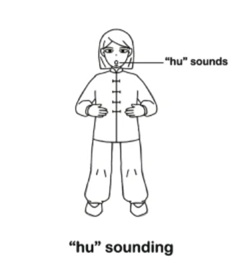
When they analyzed the sounds produced by this practitioner, they discovered something unexpected. His vocalizations contained substantial ultrasonic frequencies—sounds above the range normally considered audible to humans. In fact, nearly one-third of the acoustic energy produced during his practice was in the ultrasonic range.
That finding alone was unusual. But the researchers went further.
Using advanced brain imaging technology, they examined how the practitioner’s brain responded to ultrasonic sound. They found patterns that differed from those observed in more than 200 trained singers and vocal performers who had also been tested.
In other words, this individual appeared not only to produce unusual ultrasonic sounds but also to process them differently.
A Possible “Hidden Sense”?
This is where the study becomes especially interesting.
The researchers proposed that humans may possess sensory capacities that are not yet fully recognized by modern science. They even discussed the possibility of what they called a potential “7th sense”—a sensory mechanism that could allow the brain to detect information carried by ultrasonic vibrations.
To be clear, the study does not prove that such a sense exists.
Nor does it show that Qigong practitioners can suddenly hear sounds that others cannot hear.
However, the findings suggest that the boundaries of human perception may be more flexible than we once thought.
For Qigong practitioners, that idea may sound surprisingly familiar.
Why This Matters to Qigong Practitioners
Many people who practice Qigong describe experiences that are difficult to explain through ordinary sensory awareness alone.
They may report sensing subtle vibrations in the body, noticing changes in resonance during sound practices, or developing heightened awareness of internal sensations that were previously unnoticed.
Traditionally, these experiences are often discussed in terms of Qi.
Science approaches the question differently. Rather than asking whether Qi exists, researchers ask what physiological and neurological processes might underlie these experiences.
This study does not answer that question. But it suggests that practices involving breath, attention, and sound may interact with the nervous system in ways that scientists are only beginning to explore.
If the brain can adapt to perceive information that typically goes unnoticed, then some experiences reported during Qigong practice may deserve closer scientific investigation.
What the Study Does Not Show
As exciting as these findings are, they come with important limitations.
The study focused primarily on a single expert practitioner. That means we do not know whether the same patterns would be found in other advanced practitioners, beginners, or people who have never practiced Qigong.
The findings also do not demonstrate supernatural abilities, extrasensory perception, or proof of traditional theories about Qi.
At this stage, the study is best viewed as an intriguing scientific observation that raises new questions rather than providing definitive answers.
The Bigger Picture
Whether or not a hidden human sense ultimately exists, this study highlights something remarkable.
A traditional Qigong practice is prompting neuroscientists to explore aspects of human perception that are still not fully understood. While the findings are preliminary, they remind us that the brain may be more adaptable—and human perception more complex—than we once believed.
For now, we do not know whether Qigong can help uncover a previously unrecognized sensory capacity. But studies like this encourage scientists to ask new questions, and that is often how discoveries begin.
