Summer vacation season is here. Whether you are heading to the beach, taking a cruise, embarking on a road trip, or flying across the country, your Tai Chi or Qigong practice does not have to take a vacation.
In fact, travel can provide unique opportunities to experience these mind-body exercises in new ways. A few minutes of practice each day can help you stay energized, maintain your routine, and perhaps even deepen your awareness of how your body responds to different environments.
✈️🚗 Practicing During Air Travel and Road Trips
Getting to your vacation destination often involves long hours sitting in an airplane, car, bus, or train. While these modes of travel differ, they share a common challenge: prolonged sitting and limited opportunities to move.
Travel medicine experts recognize that remaining immobile for extended periods can increase the risk of deep vein thrombosis (DVT), a condition in which blood clots form in the deep veins of the legs. The risk is most commonly discussed in relation to long-distance flights, but it can also increase during lengthy car trips and other forms of travel that involve sitting for many hours at a time.
Fortunately, many of the principles found in Tai Chi and Qigong can be adapted to almost any travel setting.
🦵 Seated Movement Breaks
- Ankle circles
- Heel-and-toe pumps
- Knee lifts
- Gentle shoulder rolls
- Coordinated breathing exercises
These movements are similar to the calf muscle exercises and leg movements recommended by travel health experts to promote circulation during long journeys.
🌬️ A Simple Travel Qigong Practice
- Sit comfortably with your spine upright.
- Relax your shoulders and jaw.
- Breathe slowly through the nose.
- Allow the abdomen to expand gently during inhalation and soften during exhalation.
- Bring your attention to the breath for several minutes.
This simple practice may help reduce travel-related tension while keeping you connected to your regular training routine.
🚶 Keep Moving
Whenever possible, make movement breaks part of your travel plan.
- ✈️ On a plane: Stand up and walk through the cabin periodically.
- 🚗 On a road trip: Stop every couple of hours to walk, stretch, and refresh both body and mind.
These brief movement breaks not only support circulation but also complement the fundamental Tai Chi and Qigong principle that health is promoted through regular, natural movement rather than prolonged stillness.
🌊 Practicing at the Beach
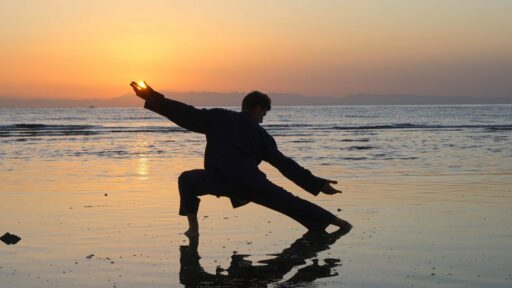
The beach can be a wonderful place for Tai Chi or Qigong.
Imagine beginning your day with the sound of waves rolling onto the shore, the fresh ocean air, and the warmth of the morning sun. The natural surroundings can help quiet the mind and create an ideal setting for mindful movement and breathing.
Yet practicing on sand presents challenges that most practitioners do not encounter on a gym floor or in a park.
Unlike a firm, level surface, sand is soft, uneven, and constantly shifting beneath your feet. As you move through weight shifts, stepping patterns, and balance transitions, the muscles in your feet, ankles, and legs must work harder to maintain stability. Even familiar movements may feel surprisingly different.
This challenge may actually be beneficial. Research has shown that Tai Chi improves balance and postural control, partly because it requires continual adjustment of body position and weight distribution. Practicing on an unstable surface such as sand increases the demand on these balance systems and may help you develop greater body awareness and concentration.
🏖️ Beach Practice Tips
✓ Choose firm, damp sand when possible.
✓ Slow down your movements and shorten your stance if needed.
✓ Pay extra attention to weight transfers.
✓ Avoid difficult single-leg balance postures if the surface feels unstable.
✓ Practice during the cooler hours around sunrise or sunset.
Rather than trying to perform exactly as you would on solid ground, allow the environment to become part of the practice. The goal is not perfection but adaptation.
🔄 Keep the Habit Alive
Perhaps the greatest benefit of practicing Tai Chi or Qigong while traveling is not physical at all.
Vacations often disrupt our normal schedules. When we stop practicing completely, it can be surprisingly difficult to restart when we return home. A brief daily session—even five or ten minutes—helps preserve the habit and maintain the connection between mind, body, and breath.
Whether you are standing on a sandy beach, watching the sunrise from a cruise ship deck, or seated on a cross-country flight, Tai Chi and Qigong remain available to you.
The setting may change, but the practice travels wherever you go.
