At the 2026 Science of Tai Chi & Qigong as Whole Person Health Conference, Dr. Eric Roseen, Assistant Professor of Medicine at the Boston University and a practicing clinician at Boston Medical Center, raised a central question:
Why does the use of Tai Chi for Knee Osteoarthritis remain low despite Tai Chi being strongly recommended by American College of Rheumatologyfor this condition?
Dr. Roseen went on to present findings from a study he led that explores this gap in adoption, focusing on the barriers that limit participation and the facilitators that could improve implementation in both clinical and community settings.
The findings point to several major barriers:
- Limited integration into healthcare systems
- Variability in how Tai Chi programs are structured and delivered
- Challenges with scalability and long-term sustainability
- Accessibility barriers for many patients with knee OA
At the same time, the research also highlights important opportunities:
- Tai Chi may be uniquely suited for community-based delivery because it often requires minimal equipment and relatively low infrastructure costs.
- Hybrid and telehealth models may further expand access for rural populations, older adults aging at home, and individuals with mobility or transportation challenges.
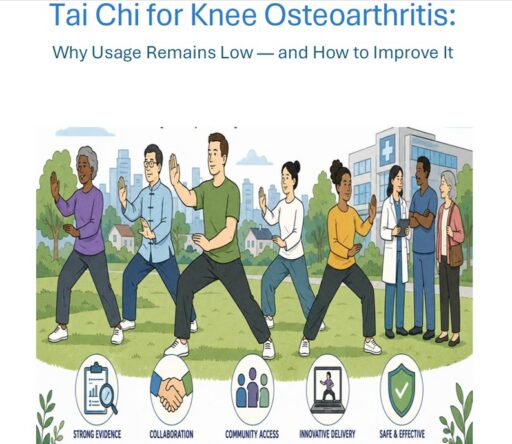
For Tai Chi teachers and organizations, this emerging implementation perspective is especially important.
The future growth of Tai Chi for knee osteoarthritis may depend not only on Tai Chi skill itself, but also on:
- Instructor preparation for clinical populations
- Structured program design
- Healthcare partnerships
- Community accessibility
- Sustainable delivery models
In our premium article, we take a deeper look at the research behind these challenges and opportunities — and explore what Tai Chi teachers, healthcare organizations, and community programs can do to improve the real-world delivery of Tai Chi for knee osteoarthritis:
- Introduction: The Gap Between Evidence and Real-World Adoption
- Strong Evidence, Limited Adoption
- Why Tai Chi Usage for Knee OA Remains Low
- Limited Healthcare Integration
- Variability in Program Structure
- Scalability and Sustainability Challenges
- Accessibility Barriers
- Why Delivery Quality Matters
- Tai Chi’s Adherence Advantage
- How Tai Chi Delivery Can Improve
- Improve Instructor Training for Clinical Populations
- Create More Structured Programs
- Strengthen Healthcare Partnerships
- Expand Community-Based Access
- Continue Developing Hybrid and Telehealth Models
- What Organizations Should Understand About Tai Chi Programs
- Looking Ahead
➡️Purchase the premium version
