Why do some people continue practicing Tai Chi for years while others gradually stop?
One of the most practical chapters in Atomic Habits offers an intriguing answer. James Clear argues that one of the fastest ways to build a new habit is to join a culture where your desired behavior is the normal behavior. The real driver isn’t simply accountability or discipline—it’s our desire to belong.
A recent study* of a 12-week virtual Tai Chi program for older adults with mobility disabilities reached a strikingly similar conclusion. Although the program focused on learning Tai Chi, participants repeatedly emphasized something else they valued: the opportunity to connect with instructors and fellow students. Many even recommended adding more time for conversation before and after class, suggesting that social connection was an important part of the experience rather than an afterthought.
Perhaps one of the hidden keys to a lasting Tai Chi habit isn’t just practicing the movements—it’s feeling that you belong.
Belonging Shapes Our Habits
According to Atomic Habits, we naturally imitate the habits of three groups:
- The close — family, friends, and coworkers.
- The many — the communities we belong to.
- The powerful — people we admire and hope to become like.
Throughout human history, belonging to a group improved our chances of survival. As a result, our brains became wired to adopt the behaviors that help us fit in.
For someone trying to establish a Tai Chi practice, this means that joining a class changes more than the learning environment. It changes the social environment. Regular practice becomes the normal behavior of the group, making it easier to repeat week after week.
Seeking the Sense of Belonging in a Virtual World
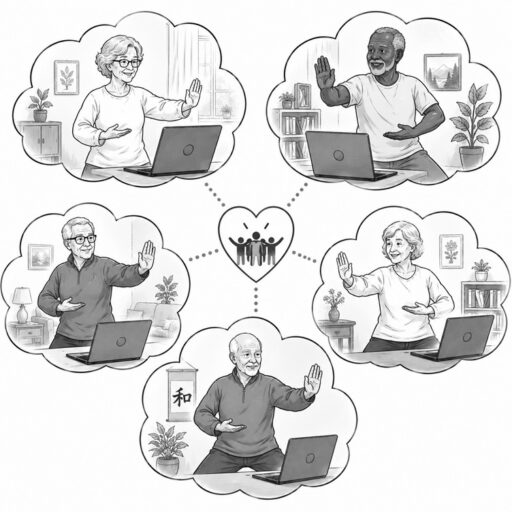
The study evaluated a virtual Tai Chi program delivered twice a week for 12 weeks to older adults with mobility disabilities. Participants appreciated the convenience of learning from home, but they consistently pointed to another benefit that surprised the researchers.
Many wanted additional opportunities to interact with classmates. Some suggested informal conversations before or after class. Others wanted more chances to exchange experiences and encourage one another.
These comments reveal that participants were seeking more than instruction. They were seeking belonging.
This finding is especially noteworthy because the classes were entirely online. Even without sharing the same physical space, participants still valued becoming part of a learning community.
Belonging Makes Habits Easier
This helps explain why practicing Tai Chi with others often feels easier than practicing alone.
When you belong to a Tai Chi community:
- You know people expect to see you.
- Missing class means missing friends, not just exercise.
- You celebrate progress together.
- You learn from one another’s experiences.
- Showing up gradually becomes part of your identity.
None of these factors relies on willpower. Instead, they make regular practice the natural thing to do.
As James Clear points out, the goal is not simply to perform a habit but to become the type of person who performs that habit.
A Tai Chi community reinforces exactly that identity.
What This Means for Teachers
The study also offers an important lesson for Tai Chi instructors.
Excellent teaching involves more than demonstrating correct movements. It also means creating an environment where students feel welcomed, recognized, and connected.
Simple practices can make a meaningful difference:
- Welcome new students personally.
- Allow a few minutes for conversation before or after class.
- Encourage students to share their experiences and questions.
- Pair experienced students with beginners.
- Stay connected between classes through an online discussion group or class messages.
These activities may seem secondary to teaching Tai Chi, but they help cultivate the sense of belonging that encourages students to return.
The Takeaway
Most discussions about building a Tai Chi habit focus on motivation, discipline, or finding enough time to practice.
Atomic Habits points to another factor: people are far more likely to sustain a habit when they belong to a group where that behavior is normal.
The new Tai Chi study echoes the same message. Participants didn’t simply value learning the movements—they valued learning together.
That sense of belonging may be one of the most overlooked reasons people continue practicing Tai Chi long enough to experience its many physical, mental, and cognitive benefits.
If you’re trying to build a lasting Tai Chi habit, don’t just ask, “When should I practice?”
Ask, “Where do I belong?”
* A Virtual Tai Chi Intervention for Older Adults with Mobility Disabilities: Results from a Single-Arm Clinical Trial with the TechSAge Tele Tai Chi Program. Healthcare, June 2026.
