At the 2026 Science of Tai Chi & Qigong as Whole Person Health Conference, a team from New York-Presbyterian | Weill Cornell Medical Center presented how Shared Medical Appointments (SMAs) enabled their innovative implementation of virtual and hybrid Qi Gong and yoga therapy programs for oncology patients within academic integrative medicine settings.
SMAs are gaining attention across healthcare as systems search for more scalable, cost-effective ways to support patients with chronic conditions and long-term recovery. Unlike traditional wellness classes, SMAs combine group-based care, patient education, clinical oversight, self-management training, and peer support.
At New York-Presbyterian | Weill Cornell Medical Center, Qigong and yoga are integrated into the SMA framework as part of an integrative medicine approach designed to help participants develop practical mind-body self-care skills.
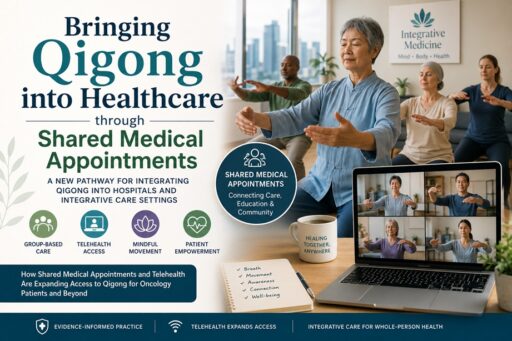
- Bringing Qigong into Healthcare through Shared Medical Appointments
- 🏥 What Are Shared Medical Appointments?
- 🌿 Why Qigong Fits the SMA Model Particularly Well
- 🫁 Qigong Encourages Self-Regulation
- ♿ Qigong Adapts Well to Diverse Patient Populations
- 🤝 The Group Structure Reinforces Practice Adherence
- 💻 Why Telehealth Matters
- 🧘 What Qigong Instructors Need to Understand About SMA Environments
- 🏥 Why Healthcare Systems Are Interested in Shared Medical Appointments
- 🔮 A Potential Turning Point for Qigong in Integrative Healthcare
- 🔑 Final Takeaways
The program also used telehealth delivery, allowing participants to attend remotely from home.
This integrative program is implemented based on a successful pilot study run by two of the conference presenters, Dr. Michelle Loy (a physician) and Tim Fatato (an experienced Qigong teacher).
Participants in the pilot study reported using breathing techniques, meditation, and movement practices outside formal sessions — an important indicator that the program supported real-world self-regulation and daily-life integration.
The group-based SMA structure also appeared to provide something many participants valued deeply: community, accountability, and shared experience.
Healthcare systems are increasingly interested in approaches that can:
- Support chronic disease management
- Improve patient engagement
- Expand access to non-pharmacological care
- Reduce isolation and stress
- Encourage sustainable self-care practices
This creates potential opportunities for Qigong instructors who understand not only movement instruction, but also group facilitation, symptom adaptation, nervous system regulation, and collaborative healthcare communication.
In our premium article, we explore:
- What Shared Medical Appointments actually are
- Why Qigong may work particularly well within SMA models
- How telehealth expands accessibility
- Practical lessons for experienced instructors
- Clinical and integrative care applications
- Safety and program-design considerations
- What healthcare organizations may look for in Qigong collaborators
As integrative healthcare continues evolving, Shared Medical Appointments may become an important pathway for bringing Qigong into broader clinical and wellness settings.
➡️Purchase the premium version
