At the 2026 Science of Tai Chi & Qigong as Whole Person Health Conference, Dr. Barbara Niles presented research on using Tai Chi for veterans with Gulf War Illness and chronic pain.
A Research Psychologist at the National Center for PTSD Behavioral Science Division at VA Boston Healthcare System and Associate Professor of Psychiatry at Boston University School of Medicine, Dr. Niles has contributed to multiple studies examining how Tai Chi may support veterans living with chronic pain, PTSD, and other complex health challenges.
As more veterans seek non-pharmacological approaches for whole-person health, this emerging research offers important insights into the future of Tai Chi programs — especially in telehealth settings and trauma-informed care models designed for veterans with PTSD and chronic pain.
Remote Tai Chi May Help Expand Access for Veterans
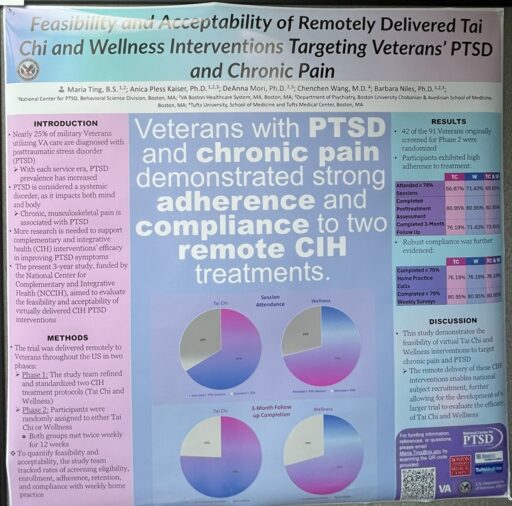
As the first author, Dr. Niles wrote a paper, published in the European Journal of Psychotraumatology, describing the development and implementation of a remotely delivered Tai Chi and Wellness intervention for veterans with chronic pain and PTSD symptoms.
Another paper of hers, published in the Journal of Psychiatric Research, reported pooled outcomes from those interventions involving veterans with Gulf War Illness (GWI) and chronic pain.
Together, the studies highlight an important issue facing veteran health programs: access.
Many veterans living with chronic pain, fatigue, PTSD symptoms, or mobility limitations may struggle to attend in-person programs consistently. Transportation challenges, rural location, physical limitations, and scheduling barriers can all interfere with participation.
The studies explored whether Tai Chi could still be delivered effectively through telehealth while maintaining participant engagement and safety.
The results were encouraging.
Veterans participating in the Tai Chi intervention showed improvements in pain interference, PTSD symptoms, depression, anxiety, mindfulness, and quality of life over time.
The studies also found that remote delivery performed similarly to in-person programming, suggesting that telehealth Tai Chi may be a practical long-term option for veteran populations.
Effective Delivery of Tai Chi: More Than the Movements
The studies also gives Tai Chi teachers and organizations a detailed look at how the intervention was actually implemented.
The remotely delivered program was carefully structured to support veterans dealing with chronic pain and PTSD-related symptoms. Researchers selected Tai Chi and Qigong movements appropriate for online learning and for participants with physical limitations. Sessions were standardized to maintain consistency across instructors and locations, which is particularly important in clinical research and healthcare settings.
But the intervention involved much more than simply teaching forms over Zoom.
Participants received instructional materials, home-practice resources, and ongoing support throughout the program. Staff members assisted with technology and logistics so instructors could focus on participant interaction and teaching. The program also incorporated Wellness education and goal-setting components aligned with the VA’s Whole Health approach.
This broader structure may be one reason the intervention was feasible for veterans managing complex health challenges.
Insights for Tai Chi Teachers and Veteran Programs
For Tai Chi teachers already working with veterans, these studies reinforce several practical ideas.
First, remote Tai Chi programs can be viable for veteran populations when appropriate support systems are in place. Second, successful programs may require more attention to accessibility, pacing, communication, and participant support than traditional community classes.
The studies also suggest that Tai Chi may fit naturally within integrative and Whole Health models increasingly used throughout VA healthcare systems. Rather than functioning only as a recreational activity, Tai Chi is being studied as part of a broader approach to pain management, mental health support, and self-regulation.
Importantly, the research does not suggest replacing traditional Tai Chi teaching.
Instead, it demonstrates how Tai Chi programs can be adapted responsibly for healthcare and telehealth environments while preserving core principles such as mindful movement, breath awareness, balance, and body awareness.
The Future of Tai Chi for Veterans May Include Telehealth
As healthcare systems continue exploring non-pharmacological approaches for chronic pain and PTSD, telehealth Tai Chi programs may become increasingly important for reaching veterans who otherwise have limited access to supportive services.
For Tai Chi organizations and instructors, the research presented by Dr. Niles offers a useful model for how traditional practices can be integrated into modern healthcare settings without losing their essential qualities.
The studies also point toward a larger shift: making Tai Chi more accessible to veterans not only through clinics and community centers, but directly in their homes.
