The Tai Chi heel kick looks simple.
Shift your weight.
Lift the leg.
Extend the heel.
Return smoothly.
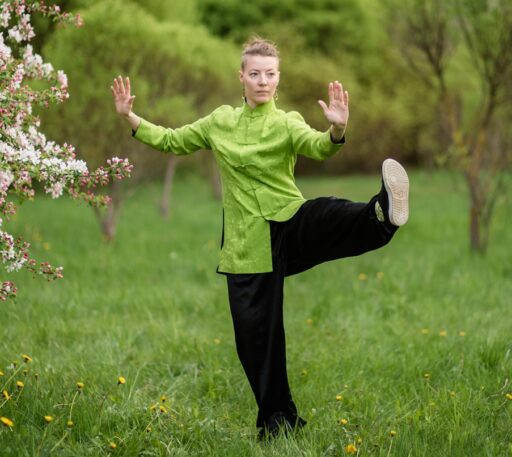
Because it appears slow and controlled, many students assume it is just a matter of balance and flexibility. If it feels unstable, they think they need stronger legs. If the knee locks, they assume they need better technique.
But recent research on elite Tai Chi athletes suggests something far more interesting: the heel kick is not mainly a strength challenge. It is a timing challenge.
When scientists analyzed heel kicks using muscle activity and movement tracking, they found that both legs use similar muscle groups—but they do not activate them at the same time. In other words, the movement may look symmetrical, but the nervous system organizes each leg differently.
The standing leg plays a far more active role than most students realize. It is not simply “holding” the body up. It is continuously adjusting through the ankle, knee, and hip to maintain balance, especially in the middle and later phases of the kick. Meanwhile, the kicking leg must be actively slowed near full extension—otherwise control is lost on the return.
This helps explain common issues instructors see:
- Lifting too early
- Knee locking
- Abrupt return
- Feeling different on each side
These are not random mistakes. They are timing problems.
In the full premium article, we break down:
- The four neuromuscular roles active during the heel kick
- Why left and right legs behave differently
- What the supporting leg is really doing
- Evidence-based verbal cues you can immediately use in teaching
If you’ve ever wondered why the heel kick feels harder than it looks, the science offers answers—and practical solutions.
👉 Read the full premium article to explore what elite Tai Chi athletes can teach us about balance, timing, and single-leg control.
